

Double Diamond QC
A Claude Code skill for building a study or teaching document that must be both accurate and clearly explained, because other people will rely on it. It runs two full Diamond QC formations in sequence: the first establishes the truth, the second makes it land, and a release gate checks the whole document before it ships.
It is the engine behind Canyon Notes: deep, layered, example-rich notes that sit above terse Cliff notes and interwoven Cliff Jumper notes.
Two failure modes, not one left standing
A study document can fail two ways, and a single review pass guards only the first:
- Wrong. A claim does not match the source, the code, or reality.
- Correct but unclear. Every sentence is true, yet the reader cannot follow it, or a “simplifying” example quietly installs a misconception.
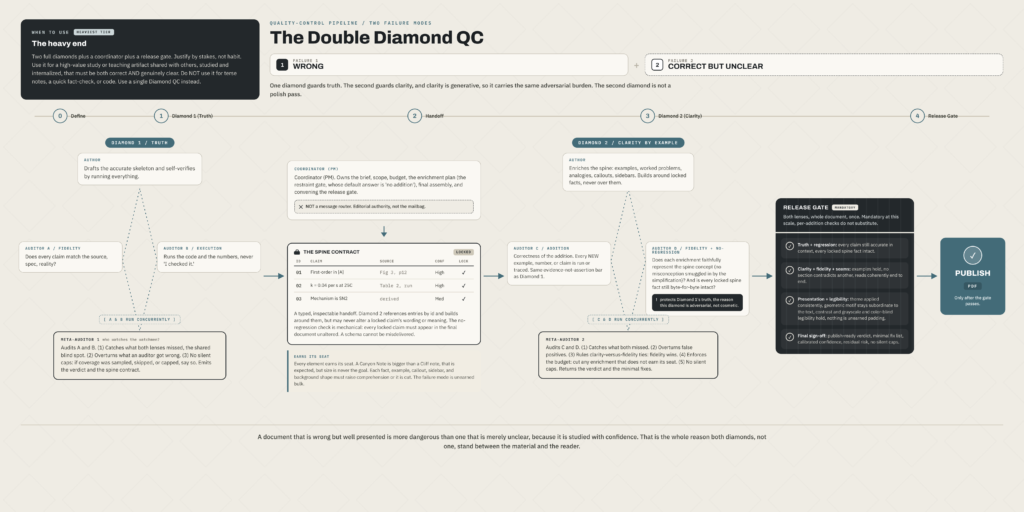
One diamond guards truth. The second guards clarity. Clarity is generative: examples, analogies, and callouts are new claims, and new claims can be false or can mislead even when literally true. So the second diamond is not a polish pass. It carries the same adversarial burden as the first, aimed at the material it adds.
How it works, the nuts and bolts
Five phases: Define, Diamond 1 (Truth), Handoff, Diamond 2 (Clarity), Release Gate.
Diamond 1, Truth
A full Diamond QC. The author drafts the accurate skeleton and self-verifies; Auditor A checks fidelity to the source; Auditor B checks by execution; the meta-auditor audits them, catching what both lenses missed (the shared blind spot) and overturning what either got wrong. Its output is the spine contract.
The handoff: coordinator and spine contract
A coordinator (PM) owns the brief, scope, budget, and the enrichment plan (a restraint gate whose default answer is “no addition”). It holds editorial authority, not the mailbag: it is not a message router.
The spine contract is a typed, inspectable handoff. Every verified fact is one locked entry (id, claim, source, confidence). Diamond 2 builds around these by id but may never alter a locked claim. The no-regression check is then mechanical: every locked claim must appear in the final document unaltered. A schema cannot be misdelivered.
Diamond 2, Clarity by example
A second full diamond. The author enriches the spine with examples, worked problems, analogies, callouts, and sidebars. Auditor C checks the correctness of every new addition by running or tracing it. Auditor D checks fidelity and no-regression: does each enrichment faithfully represent the spine concept, and is every locked fact still byte-for-byte intact? Meta-auditor 2 audits them and rules any clarity-versus-fidelity tie in favor of fidelity.
The release gate
Mandatory at this scale. Both lenses re-examine the whole assembled document at once: truth and regression, clarity and fidelity and seams, presentation and legibility, then a final sign-off. Only after the gate passes is the PDF released.
Every element earns its seat. A Canyon Note is bigger than a Cliff note, but size is never the goal: each fact, example, callout, and sidebar must raise comprehension or it is cut.

When to use it, handsomely
This is the heavy end: two full diamonds plus a coordinator plus a release gate. Justify it by stakes, not habit.
- Use it for a high-value study or teaching artifact that is shared with others, studied and internalized, and must be both correct and genuinely clear. Canyon Notes for a midterm shared with a cohort is the central case.
- Do not use it for terse personal notes, a quick fact-check, or code. Use a single Diamond QC instead.
This skill is a layer over Diamond QC. Read that skill for the per-diamond mechanics; this one adds the second diamond’s aim, the coordinator, the spine contract, and the gate.
What you need to move it, move it.
- Claude Code installed.
- The Diamond QC skill, since each diamond here is a Diamond QC. Install it alongside this one.
- Otherwise nothing: the auditors run as Claude Code subagents, so no extra dependencies, API keys, or services.

Install!
Clone (or copy) the skill into your Claude Code skills directory.
User-level (available in every project):
git clone https://github.com/DatJavaClass/double-diamond-qc.git ~/.claude/skills/double-diamond-qc
Project-level (this repo only):
git clone https://github.com/DatJavaClass/double-diamond-qc.git .claude/skills/double-diamond-qc
On Windows the user-level path is %USERPROFILE%\.claude\skills\double-diamond-qc.
Claude Code discovers a skill by the
SKILL.mdat the root of its folder, so the folder must be nameddouble-diamond-qcand containSKILL.mddirectly.
Use
Ask Claude Code to run it, or name it directly:
- “Double Diamond this study guide before I share it.”
- “Build Canyon Notes for this chapter.”
- Or any request to build a thorough, shared study document that must teach clearly without sacrificing correctness.
Claude runs Diamond 1, hands off the locked spine, runs Diamond 2, then the release gate.
And viola! You’ve unleashed your own Double Diamond QC!

One of the many things you can make with Double Diamond QC are half semester long study guides, like this one.